Our New Robber Barons
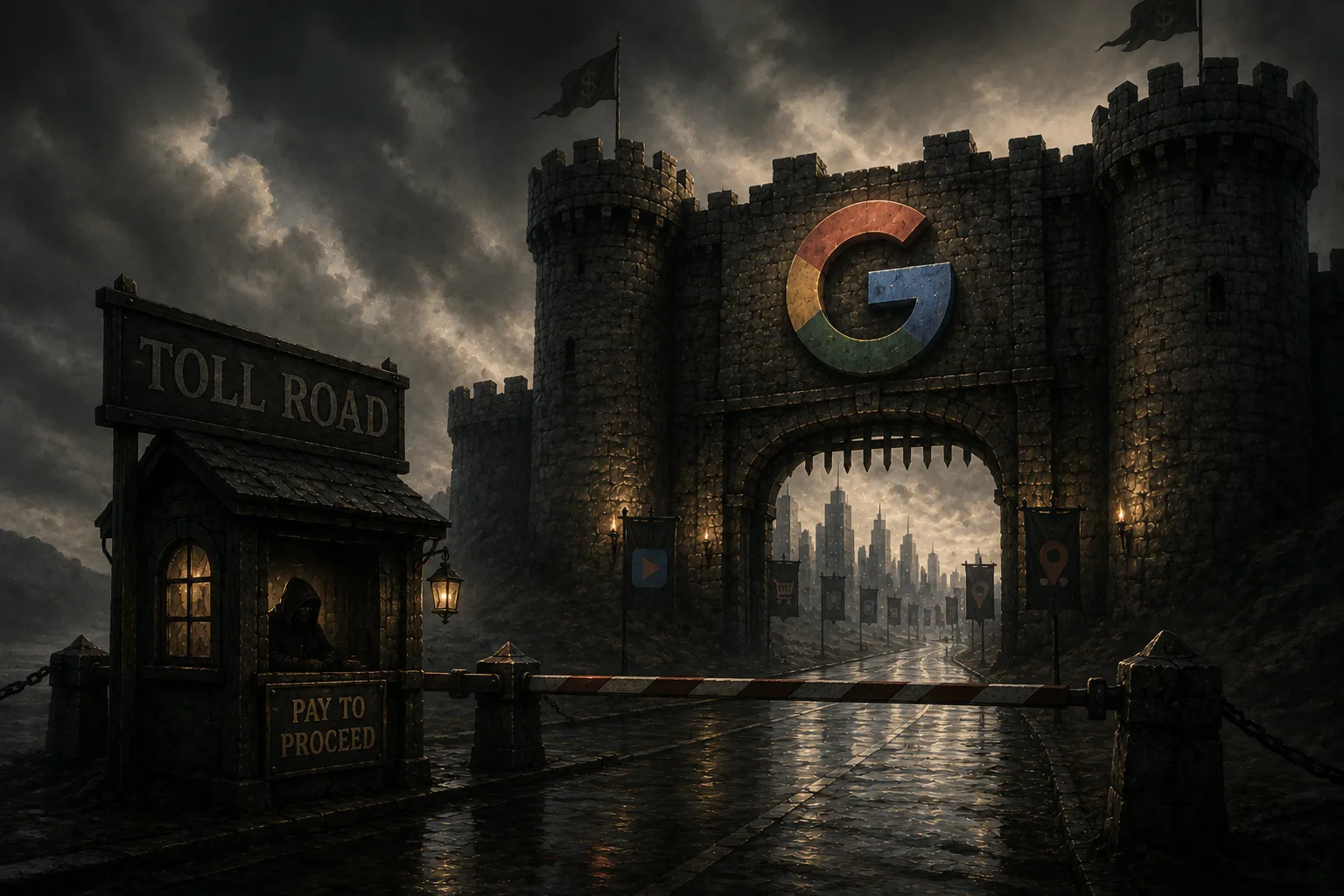
How SoftBank and Google rebuilt the medieval toll road — and arranged for someone else to pay the toll.
In the German Rhineland of the fourteenth century, a certain kind of nobleman discovered that the surest way to wealth was not to make anything, nor to trade anything, but to own a chokepoint. He built his castle above a bend in the river, strung a chain across the water, and charged every passing barge for the privilege of continuing. The Germans had a word for him: Raubritter, the robber knight. He was not a bandit in the gutter sense. He had a title, a coat of arms, and, crucially, a plausible claim that the toll was lawful. He robbed from above, through position, with paperwork.
We retired the chains and the castles. We did not retire the model. Five centuries later, when American historians needed a name for the men who cornered the railroads, the oil, and the steel — Vanderbilt, Gould, Rockefeller — they reached back and called them robber barons. The phrase stuck because it captured something the law could not punish: a fortune extracted not by breaking the rules but by owning the road everyone else had to travel.
The robber barons of our moment do not own oil or rail. They own capital and they own attention, and they have learned to do with venture money and ad auctions what the Raubritter did with a river. Their names are SoftBank and Google. Their toll roads are invisible. And the people paying the toll — small operators, working families, the merely solvent — mostly never see the chain go up.
The blitzscaler’s gambit
Begin with SoftBank, because SoftBank is the purest distillation of the method. Through its Vision Fund — at launch the largest pool of venture capital ever assembled, roughly a hundred billion dollars, much of it sovereign money from the Gulf — SoftBank pioneered a strategy its admirers call blitzscaling and its victims experience as something closer to arson.
The logic is simple and, on its own terms, rational. Identify a fragmented industry full of unglamorous incumbents who actually turn a profit — storage, moving, office subleasing, taxis. Pour in a sum of capital so large that the ordinary laws of business no longer apply to the company receiving it. Use that capital to sell below cost, sometimes far below, capturing customers an honest competitor could never afford to win. Grow at a speed that has nothing to do with whether the underlying business works, because the goal is not yet profit. The goal is dominance, and dominance, the theory holds, can be monetized later.
For the incumbents, this is not competition in any sense they recognize. A moving company that has spent twenty years building a book of business, paying its crews, servicing its trucks, and clearing a modest margin cannot match a rival pricing every job at a loss, indefinitely, on someone else’s billions. The incumbent is not being out-managed. He is being out-funded, which is a different thing entirely, and there is no operational excellence that defeats an opponent who has decided not to care about money.
Consider Clutter, a Culver City startup that promised to disrupt storage and moving with an app. In 2019 SoftBank’s Vision Fund led a two-hundred-million-dollar round, bringing Clutter’s total funding to nearly three hundred million and its valuation to a reported six hundred million. The press releases spoke of revolutionizing a “vast and traditional market.” Translated, that meant entering the same business as thousands of independent movers and storage operators while carrying a war chest none of them could dream of.
By 2023 Clutter had run out of road. Cash reserves were projected to be exhausted, it could not raise more, and a secured lender foreclosed; the husk was absorbed by Iron Mountain. The six hundred million was, for practical purposes, gone. But here is the part that the obituaries missed: the capital did not simply vanish into the founders’ pockets, and it did not build a lasting company. A great deal of it was spent — burned, in the industry’s own cheerful verb — competing against businesses that had done nothing wrong except exist in a market a megafund had decided to conquer. Some of those businesses did not survive the years Clutter spent underpricing them. When the subsidized giant finally collapsed, the market it had distorted did not snap back to its old shape. The damage to the incumbents was permanent. The damage to the giant was a line item in a fund that had hundreds of other bets.
This is the first toll. The incumbent pays it whether the blitzscaler wins or loses. SoftBank has done this across an entire portfolio — most spectacularly with WeWork, which it inflated toward a forty-seven-billion-dollar valuation before the 2019 IPO collapsed and the company eventually slid into bankruptcy. The losses landed on SoftBank’s own books and on its sovereign backers, who can absorb them. The collateral damage landed on landlords, employees, and the more sober competitors who had been told for years that their refusal to lose money was a failure of vision.
The house that always wins
Now turn to Google, whose role is quieter and, in some ways, more elegant.
A consumer startup of the blitzscaling type has one overriding expense: acquiring customers. And in the modern economy, acquiring customers means buying attention, and buying attention means buying ads, and buying ads means, overwhelmingly, paying Google and Meta. A large share of every venture megaround raised to “disrupt” some industry does not stay in that industry at all. It flows, almost on a conveyor belt, into the digital advertising auction. The startup is merely the vessel that carries investor money from a fund to a platform.
The platform, unlike the startup, cannot lose. It does not care whether the advertiser ever turns a profit, whether the unit economics close, whether the company exists in three years. It collects its toll on the spend itself, in real time, on the way through. A startup can burn nine dollars to bring in ten, can chase customers whose lifetime value will never exceed what was paid to acquire them, can do this for years — and at every step, the platform takes its cut and keeps it. When the startup finally dies, the platform has already been paid. This is the river and the chain, rebuilt in code.
There is a further wrinkle, and it is the one that should trouble us most. Google does not merely collect the toll; through its venture arm, GV, it has at times been an investor in the very companies that pour money back into its ad business. GV was among the backers of Clutter. There is nothing illegal in this, and the two operations are formally separate. But step back and look at the shape: a firm whose fund holds a stake in a startup, and whose advertising business captures that startup’s spending, profits on the way in and on the way out, and is insulated from the startup’s eventual fate. The venture loss, if it comes, is small and diversified. The advertising revenue is large and certain. The house owns a chip on the table and also rakes the pot.
None of this requires a conspiracy. It requires only that powerful actors follow their incentives, and that the rules permit it. That is precisely what made the original robber barons so hard to dislodge. They were not criminals. They were structures.
Who actually pays
It is tempting to file all of this under “investors losing investors’ money,” a spectacle that invites little sympathy. SoftBank’s backers are sovereign wealth funds; if the Vision Fund torches ten billion dollars, the tears are hard to summon.
But the cost does not stay contained. It radiates outward in at least three directions, and every one of them eventually reaches people who never bought a share of anything.
It reaches the incumbent operators — the movers, the storage owners, the drivers — whose profitable, tax-paying, job-providing businesses were degraded or destroyed by competitors who were never trying to make money in the first place. These were not failures of skill. They were the predictable casualties of a strategy that treats below-cost pricing as a weapon and treats other people’s livelihoods as terrain.
It reaches the workers, who staffed the subsidized boom and then absorbed the bust — hired in the expansion, discarded in the contraction, after which the “disruption” turned out to have disrupted mostly them.
And it reaches the wider public through the markets themselves. When these valuations are marked up — SoftBank recently booked enormous paper gains as its stake in OpenAI was revalued from roughly two hundred sixty billion dollars to seven hundred thirty billion within a single year — those gains ripple through index funds, pensions, and retirement accounts that ordinary people hold without ever choosing to bet on a money-losing AI lab. If the markups are real, the public shares modestly in the upside. If they are a bubble, the public shares fully in the downside, because that is how bubbles distribute their pain: the gains were always concentrated, and the losses are always broad.
This is the deepest sense in which the phrase robber baron earns its keep. The defining feature of robbery from above is not that a law is broken. It is that the wealth flows reliably upward and the risk flows reliably down, and the arrangement is perfectly, infuriatingly legal.
The case for the defense
An honest accounting must admit what the blitzscalers would say in reply, because some of it is true.
Capital deployed at this scale does sometimes build things that endure. The chips Arm designs are real and profitable. Data centers get built. Technologies that would not otherwise exist come into being on the strength of patient, loss-tolerant money — and patient, loss-tolerant money is genuinely scarce and genuinely useful. Not every high valuation is a bubble, and not every failed startup is a crime against the incumbents it challenged. Sometimes the incumbent really was complacent, overpriced, and ripe for replacement, and the customer is better off for the disruption.
Investors who lose their money, moreover, are adults who chose the risk. SoftBank’s sovereign backers were not defrauded into the Vision Fund; they walked in with open eyes and deep pockets. And the discipline of the market does eventually assert itself: Clutter died, WeWork’s valuation cratered, the reckoning comes. The system, its defenders insist, is self-correcting, and the corrections — however brutal — are the price of the dynamism that also produced everything good about the modern economy.
These arguments are not worthless. The trouble is that they describe the system’s intended operation, while the robber-baron critique describes its distributional reality — and both can be true at once. Capital can build real things and still concentrate the gains while socializing the risks. The market can correct and still leave a graveyard of honest competitors who were collateral, not casualties of their own failure. To say the model sometimes produces value is not to answer the charge. The Raubritter, after all, also maintained the occasional bridge.
The toll we tolerate
The medieval robber knights were eventually brought down not by competition but by a political choice. The leagues of merchant cities, tired of paying to use their own rivers, organized, and the law was changed to make the chains illegal. The tolls did not fall because the knights reformed. They fell because the people paying decided they would no longer pay.
We are not there yet, and perhaps we will not get there. The new toll roads are harder to see than a chain across a river; the harm is diffuse, the mechanism is technical, and the language we have inherited — “thief,” “fraud” — is either too small or too legally precise to fit. That is why the older phrase matters. Robber baron names the thing exactly: extraction by the powerful, through the structure, under the cover of law, with the bill mailed quietly to everyone else.
The independent mover who lost his business to a company that was never trying to make money understands this in his bones, even if he cannot find the word for it in a statute. He is not the victim of a pickpocket. He is the merchant on the river, watching the chain go up, being told that the toll is perfectly legal.